

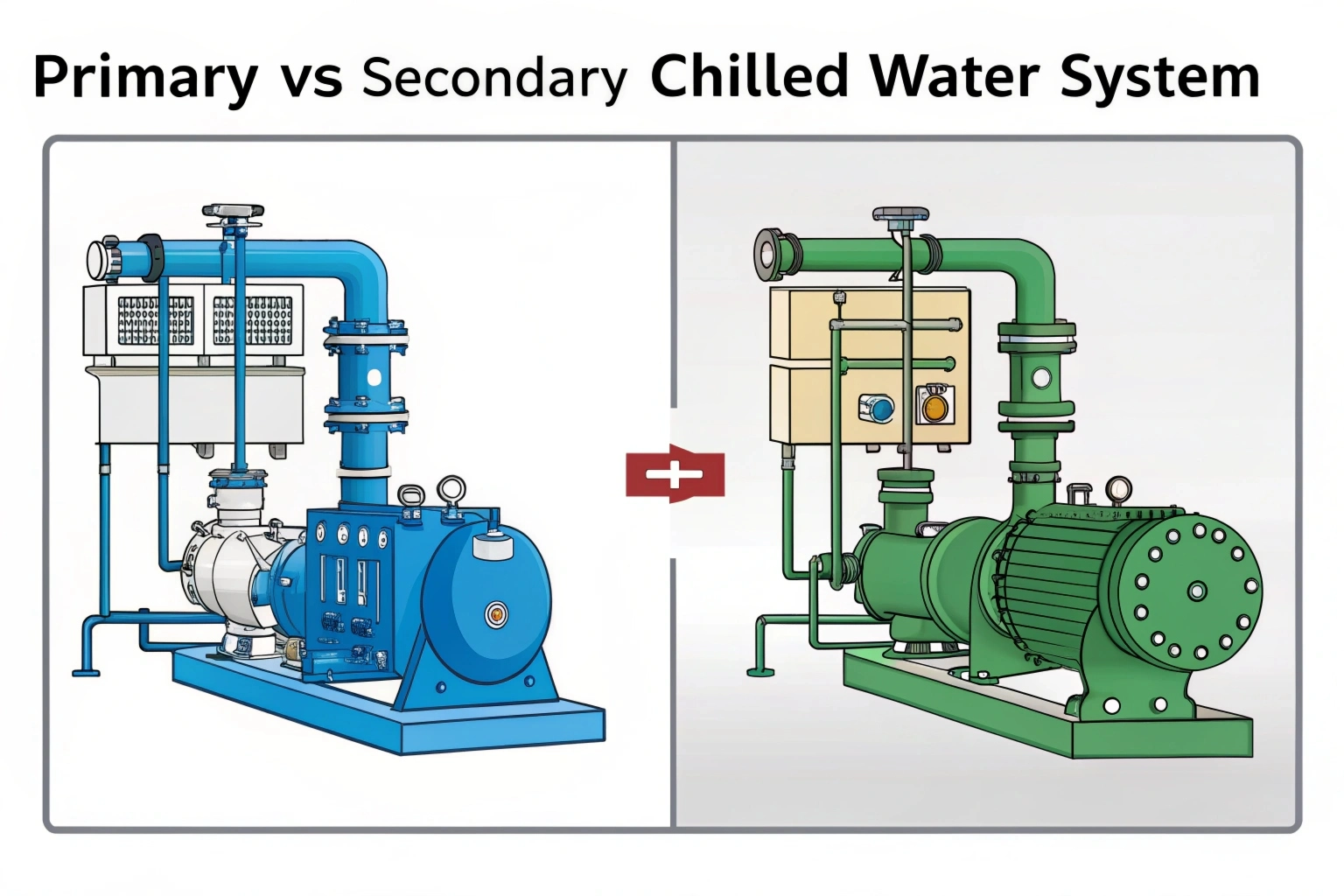
If you’ve ever looked at a chilled water system and felt confused by all of the pipes, pumps, and loops, well, don’t worry-we’ve all been there. The primary–secondary chilled water system does sound complicated but once you break it down piece by piece it’s actually very logical.
Think of something like a school canteen. One team cooks the food, and another team serves it to students. Both perform different jobs, but together, they ensure that everyone gets fed without chaos.
What Is the Primary Chilled Water System?
The primary system basically acts as the heart of the plant. Its only duty is the transportation of water inside the chiller.
Nothing more. Nothing less.
The primary pumps force water through the chiller evaporator.
Flow remains steady, since chillers require stable flow conditions to operate efficiently.
Whatever the building load, primary flow does not change.
You can consider the primary system as the “closed loop with a fixed job.”
What Is the Secondary Chilled Water System?
Now, the secondary system takes chilled water from the primary loop and supplies it to the building — the AHUs, FCUs, and coils.
The secondary pumps handle the variable flow.
They speed up or slow down based on the cooling load.
If the building needs less cooling, secondary pumps reduce flow.
When demand rises, they scale up.
This is a flexible system since the building loads change all day.
So Why Do We Use Two Separate Loops?
The simple answer:
Because chillers want stable flow, while buildings never have stable cooling demand.
The main loop protects the chillers.
The secondary loop does the service within the building. If we used only one loop, then either the chiller would suffer from unstable flow or the building wouldn’t get proper cooling. Neither is good.
Decoupler Pipe — The “Peace Maker” Between Both Loops
Both loops are then connected together with a decoupler line, also widely known as a bypass pipe.
This pipe:
Balances flow
Prevents fighting between pumps
Keeps chillers happy even when the secondary flow drops
Helps to avoid low-flow shutdowns
It’s basically the “no-drama zone” of the system.
What Happens When Secondary Flow Is Higher Than Primary Flow?
This is the usual case when the building load is high.
The secondary pumps suck more water than the primary pumps supply.
Warm water coming from the return side gets pulled into supply by means of the decoupler.
Supply temperature increases slightly.
This tells the system: “Hey, load is increasing.”
What Happens When Secondary Flow Is Lower?
Meaning, the building does not require much cooling.
Extra primary water flows backward through the decoupler.
Chillers may cycle or stage down.
Pump power decreases.
This is normal during morning hours, winter, or low occupancy.
Advantages of Primary–Secondary System
Here are the advantages in simple, easy-to-understand language:
Chillers remain protected: constant flow and no sudden shocks.
Energy savings – secondary pumps adjust to real load.
Better comfort: AHUs receive proper temperature water.
Ideal for large buildings where cooling demand keeps swinging.
Where Is This System Commonly Used?
You will see it in:
Malls
Airports
Hospitals
Large offices
Universities
District cooling systems
This setup is usually preferred for any building with dynamic cooling needs.
Simple Example to Make It Crystal Clear
Assume there is a delivery system.
Primary loop = Factory trucks → They move goods from factory to warehouse.
Secondary loop = delivery vans, which deliver merchandise to homes.
The trucks always run on the same road and speed.
Vans change their routes and speed depending on demand. Both in combination make the system efficient.
Primary vs Secondary Chilled Water System: Final Thought
The primary–secondary chilled water system is one of the smartest and most dependable designs used in HVAC. And once you understand that each loop has its own job — one stable, one flexible — the whole thing starts to make complete sense.
You don’t have to memorize formulas to understand it. You just need to see how the concept flows.
Have Specific Equipment or Plant Capacities to Calculate?
Our AI Specialist can troubleshoot technical issues, calculate duct velocity, determine chiller load, or size cables specifically for "Primary vs Secondary Chilled Water System: A Simple Explanation".

popeye21834
Licensed Engineering ContributorChartered Senior MEP Engineer & Review Board Specialist with extensive design, testing, and commissioning field experience across commercial and industrial infrastructure.

Leave a Reply