Air filtration in central air frameworks eliminates residue, allergens, and toxins from indoor air, further developing wellbeing and solace. Picking the right channels and keeping up with them routinely assists keep with circulating clean, energy costs low, and the framework productive.Air filtration in central air frameworks accomplishes something beyond cool or intensity — it cleans your air, eliminating residue, allergens, and microorganisms. Realizing how channels work and picking the right one keeps your indoor air new and sound.Remain with us to figure out how air filtration in central air frameworks keeps your home protected and agreeable. We’ll cover different channel types, support tips, and how clean air can work on your wellbeing and prosperity. We should make a plunge together!
Importance of Air Filtration in HVAC Systems
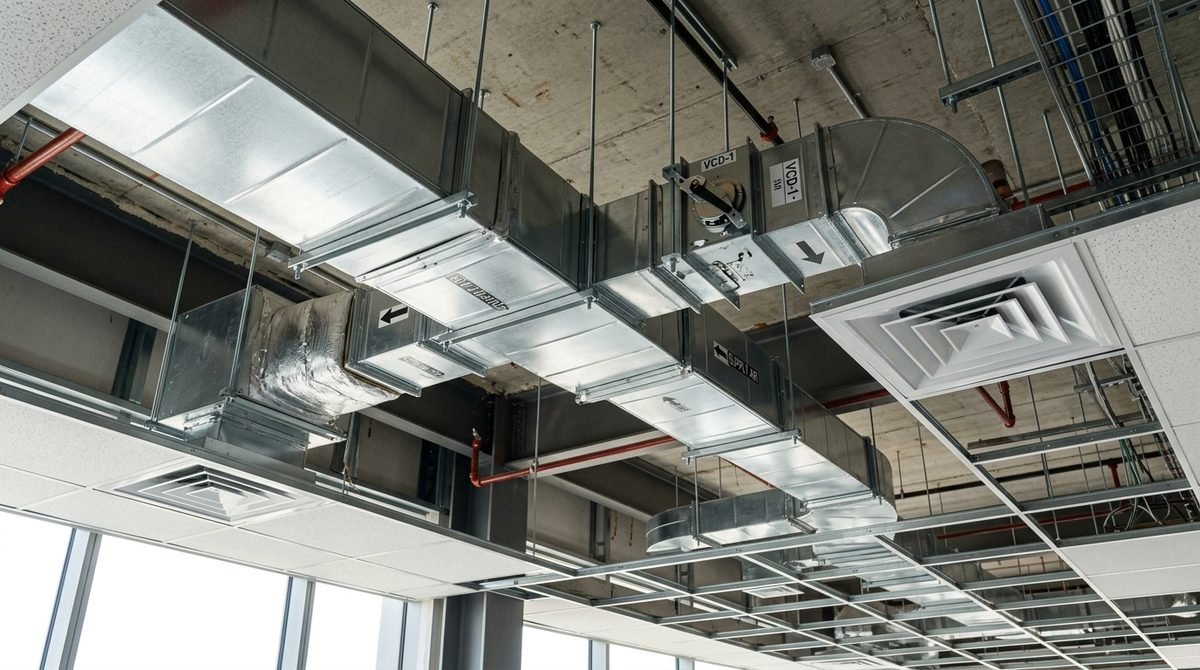
Importance of Air Filtration in HVAC SystemsThe job of air filtration in central air (Warming, Ventilation, and Cooling) frameworks is critical for guaranteeing high indoor air quality. The filtration interaction eliminates particulate matter, toxins, and allergens, shielding tenant wellbeing and upgrading solace. Compelling filtration additionally saves the central air framework’s parts by keeping residue and foreign substances from aggregating, which can debilitate effectiveness.Central air channels range in proficiency, catching particles of different sizes. They are evaluated by the Base Proficiency Detailing Worth (MERV), which shows a channel’s capacity to trap particles. Higher MERV-evaluated channels catch more modest particles yet may likewise confine wind current, possibly expanding energy utilization. Thus, selecting the appropriate filter requires balancing air quality needs with system compatibility.
Benefits of Effective Filtration:
Reduces allergy and asthma triggers
Prolongs HVAC system life
Maintains consistent airflow
Lowers maintenance costs
Types of Air Filters Used in HVAC Systems
Air channels in central air frameworks change in piece and productivity. Normal channel types incorporate fiberglass, creased, high-effectiveness particulate air (HEPA), and electrostatic channels. Fiberglass channels are reasonably yet less powerful in catching more modest particles, while creased channels have a bigger surface region, further developing the filtration limit. HEPA channels offer the most elevated proficiency, frequently utilized in conditions requiring sterile air, similar to medical clinics.Electrostatic filters attract particles using electrostatic charges, proving effective in capturing fine particles. However, their efficiency varies with humidity and maintenance frequency. Choosing the right filter type depends on the application, indoor air quality requirements, and budget constraints.
Filter Type
Efficiency Level
Application
Fiberglass
Low
Basic residential
Pleated
Moderate
Residential and commercial
HEPA
High
Medical and clean-room environments
Electrostatic
Moderate
Residential and commercial
Understanding MERV Ratings and Their Impact
The MERV rating (going from 1 to 16) measures an air channel’s adequacy in catching airborne particles. Channels with a MERV rating of 1-4 eliminate enormous particles yet are lacking for further developing air quality, reasonably fundamentally for essential private use. MERV appraisals of 13-16 are frequently saved for clinical offices because of their capacity to catch particles less than 0.3 micrometers, including microbes and infections.Nonetheless, higher MERV evaluations can prompt expanded obstruction in the air conditioning framework.As filter efficiency increases, so does the potential for airflow restriction, resulting in elevated energy consumption. The energy impact (EEE) can be modeled as:E∝1Airflow Rate (Q)E propto frac{1}{text{Airflow Rate (Q)}}E∝Airflow Rate (Q)1where increased resistance reduces QQQ, raising operational energy requirements.
Optimal MERV Selection:
Residential use: MERV 5-8
Commercial spaces: MERV 9-12
Healthcare: MERV 13-16
Maintenance and Replacement of HVAC Filters
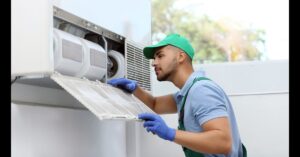
Maintenance and Replacement of HVAC FiltersAs part of routine maintenance, HVAC filters need to be performed. Stopping or pollution from normal exams explains diminished wind streams and enhanced energy costs. Channels should be replaced every 1-3 months for most private frameworks addressing channel type, natural variables, and use frequencies. But neglecting to replace will mean compromised air quality and finally, straining the system.Certain filter types could vary between replacement intervals. For example, creased channels usually last longer than fiberglass, and HEPA channels need more frequent checks because of their more effective molecule catch rate. A support plan spares central air time and money by laying out a plan for support.
Signs of Needed Replacement:
Visible dust on filter surface
Reduced airflow from vents
Increased energy bills
Role of Air Filtration in Reducing Energy Consumption
Air filtration can impact an HVAC system’s energy consumption. While high-efficiency filters capture more particles, they often impose greater resistance, affecting the airflow rate. The relationship between energy consumption (EEE) and filter resistance (RRR) can be expressed as:E=k⋅RE = k cdot RE=k⋅Rwhere kkk is a constant depending on system properties.Selecting the correct filter ensures balanced energy consumption without sacrificing air quality. Improperly selected filters, especially high-resistance ones, can strain the HVAC system’s blower motor, increasing operational costs. Energy-efficient filters provide an optimal balance, preserving air quality and managing power usage.
Energy-Saving Tips:
Use filters appropriate for your HVAC system’s specifications
Replace filters regularly to prevent excessive resistance
Opt for MERV 8-12 filters in residential settings to balance efficiency and energy use
Technological Advancements in HVAC Air Filtration
Technological Advancements in HVAC Air FiltrationDevelopments in central air filtration innovation have presented savvy channels, which screen air quality and ready clients when substitution is required. These channels coordinate sensors to follow particulate amassing, taking into account opportune upkeep. Also, high level materials like nanofiber and carbon-implanted channels improve contamination expulsion, guaranteeing cleaner air with negligible effect on wind stream.Bright (UV) light innovation is another progression, frequently joined with conventional channels to kill microorganisms. UV channels can decrease the requirement for high-effectiveness channels in unambiguous settings by giving beneficial air cleaning.
Future of Filtration:
Smart sensors for maintenance alerts
Integration of UV and traditional filtration for pathogen reduction
Enhanced filtration media (nanofibers, activated carbon)
Air filtration includes eliminating residue, allergens, and poisons from the air. Channels trap these particles, further developing indoor air quality and making the air better to relax.
What to know about HVAC filters?
Air conditioning channels are fundamental for cleaning the air in warming and cooling frameworks. They come in different kinds and effectiveness levels, and ordinary substitution is significant for ideal execution and energy reserve funds.
What is filtration in HVAC?
Filtration in central air alludes to the most common way of eliminating undesirable particles from the air circling through the warming, ventilation, and cooling framework. This keeps a spotless and sound indoor climate.
How many types of air filters are there in HVAC?
There are a few kinds of air channels in central air frameworks, including fiberglass, creased, HEPA, and electrostatic channels. Each type has different filtration capacities and productivity levels.
What are the three types of air filters?
The three fundamental kinds of air channels are:
Fiberglass channels : Fundamental channels that catch bigger particles.
Creased channels : More powerful, with a bigger surface region for better filtration.
HEPA channels : High-proficiency channels that catch tiny particles, ideal for sensitivity victims.
Conclusion
As the name suggests, HVAC = air conditioning plus heating. Air filtration in HVAC systems is one important process that contributes to improving the indoor air quality and also health of people. Using the right filter type (pleated or HEPA), and keeping it clean and working, will reduce allergens, dust, and all harmful pollutants in your home or work environment. Additionally, the knowledge of the value of air filtration in HVAC systems not only ensures more comfort, but it has a positive influence on energy efficiency as utility bills are reduced. Being able to educate yourself on the different filter types and whether or not they will be effective for your indoor environment allows you to make better choices for clean air for you and your family.
Found this technical guide useful? Share with fellow engineers:
Have Specific Equipment or Plant Capacities to Calculate?
Our AI Specialist can troubleshoot technical issues, calculate duct velocity, determine chiller load, or size cables specifically for "Everything You Need to Know About Air Filtration in HVAC Systems".
Chartered Senior MEP Engineer & Review Board Specialist with extensive design, testing, and commissioning field experience across commercial and industrial infrastructure.
Point-to-point AI consultation is exclusively available for verified subscribers. Register below for manual review (no payment gateway or credit card required).
✓NBC 2016 & ASHRAE Codes
✓Instant Formula Derivations
✓9 Engineering Disciplines
✓Direct Plant Equipment SOPs
Suggested:
Your Engineering Query:
Calculating Chiller Approach Temperature & Surging...
Verified Point-to-Point Diagnostic Solution
National Building Code (NBC) & ASHRAE Standards
Formulating thermodynamic derivations and code clauses...




Leave a Reply