











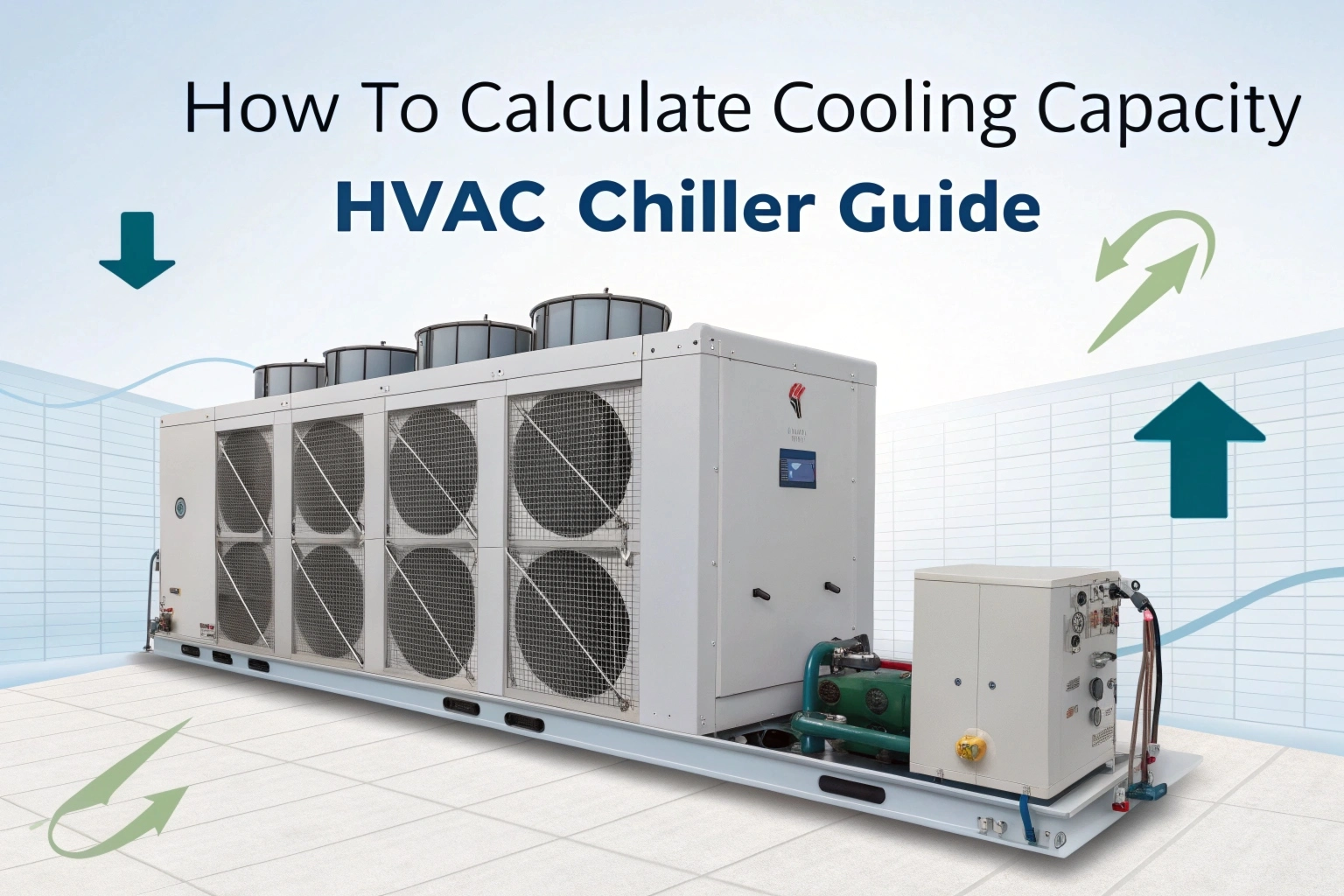
When working in HVAC, one of the most confusing things at the beginning is figuring out how much a chiller can actually cool. And honestly, I get it-the formulas look scary, the units feel weird, and everybody on site talks about it like it’s super simple. But once you understand the logic behind it, the calculation of chiller capacity becomes surprisingly easy. Let’s break it down in simple, human language.
What Cooling Capacity Actually Means
Cooling capacity essentially tells you how much heat a chiller can remove from the water passing through it. Since HVAC is all about keeping buildings comfortable, this capacity decides whether a chiller is perfect for a project or not. If your chiller is too small, rooms won’t cool properly. If it’s too big, you waste energy and money.
So, the objective is straightforward: know how much cooling the chiller provides.
The Formula for Cooling Capacity
A lot of beginners ignore ΔT, but it’s really the heart of the calculation: if ΔT goes up, so does cooling capacity. If ΔT drops, so does capacity. That’s why many engineers design chilled water systems with a 5°C or 6°C ΔT – it keeps the chiller running efficiently without oversizing pumps or pipes.
These aren’t universal, but they help:
Chilled water temperature in = 12°C
Chilled water temperature out = 7°C
So ΔT = 5°C
Flow rate is usually based on 0.24 L/s per ton (approx.
Step-by-Step Example (Super Easy)
Let’s say:
- Chilled water flow rate = 50 L/s
- Temperature difference (ΔT) = 5°C
Step 1: kW Calculation
Cooling Capacity = 4.187 × 50 × 5
Cooling Capacity = 1,046.75 kW
Step 2: Convert to Tons
Cooling Capacity (TR) = kW ÷ 3.517
Cooling Capacity (TR) ≈ 297.6 TR
So the chiller is roughly 300 TR.
Once you try this a couple of times, it becomes second nature.
Why Temperature Difference Matters So Much
A lot of beginners ignore ΔT, but it’s honestly the heart of the calculation. If ΔT goes up, cooling capacity increases. If ΔT drops, capacity drops too. That’s why many engineers design chilled water systems with a 5°C or 6°C ΔT — it keeps the chiller running efficiently without oversizing pumps or pipes.
Typical Values You Should Know
These aren’t universal, but they help:
- Chilled water temperature in = 12°C
- Chilled water temperature out = 7°C
- So ΔT = 5°C
- Flow rate is usually based on 0.24 L/s per ton (approx.)
These shortcuts help when you’re doing quick mental checks on-site.
Common Mistakes People Make
Even experienced people mess this up sometimes. Here are the big ones:
- Incorrect usage of the flow rate
Take the design flow, not pump flow unless specified.
- Confusion of units
Tons, kW, L/s — they all change the answer. Be careful. 3. Neglecting the real operating ΔT Sometimes the installed system runs at a lower ΔT. This reduces capacity. 4. Forgetting to convert tons properly One ton = 3.517 kW – that number is your best friend
Where This Calculation Is Used in Real Projects
Chiller capacity calculations show up everywhere:
Chiller selection
Checking System Efficiency
Design of chilled-water pumps
Approving vendor datasheets
Troubleshooting low cooling issues
So, learning this is not just academic; it’s something you actually will use on the job.
Estimating the cooling capacity of a chiller is really not that difficult once you understand what each number means. So long as you know the flow rate and the temperature difference, you can figure out the chiller’s performance in just a few steps. And honestly, that’s what HVAC engineering is mostly about — breaking down complicated ideas into simple, practical steps.