









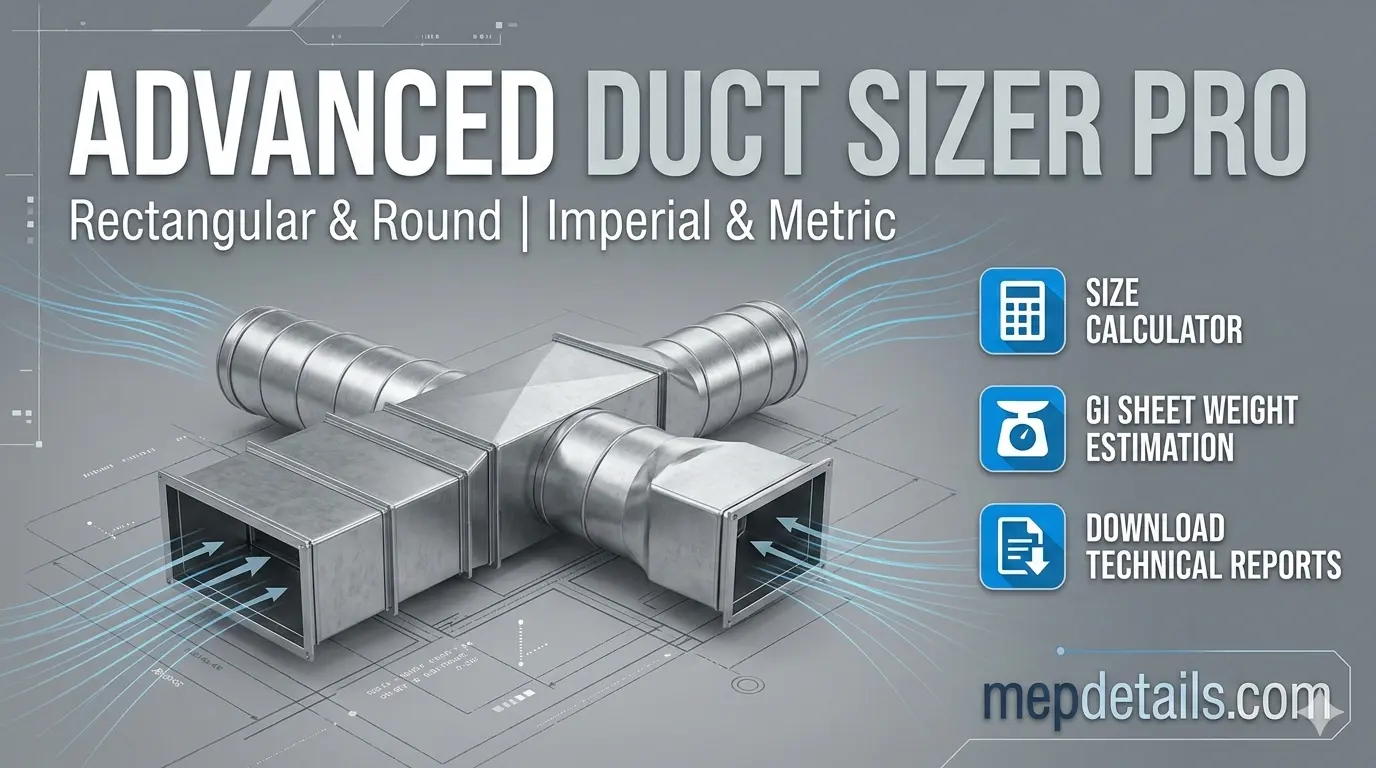
This Duct Sizer Online tool is designed to assist MEP engineers, HVAC contractors, and designers in determining the optimal duct size and estimating material requirements. Follow these steps to get accurate results:
ENGINEERING REPORT
Calculated Duct Size:
Estimated Sheet Weight:
Note: The result is the net metal weight. Always add 10-15% extra for flanges, joints, and scrap wastage.
1. Select Measurement Units
Choose your preferred unit system using the toggle at the top:
- Imperial: Measurements in Inches, Airflow in CFM (Cubic Feet per Minute), and Velocity in FPM (Feet per Minute).
- Metric: Measurements in mm, Airflow in m³/h (Cubic Meters per Hour), and Velocity in m/s (Meters per Second).
2. Choose Duct Shape
Click on the appropriate tab:
- Rectangular: For square or rectangular sheet metal ducts.
- Round: For circular spiral pipes or flexible ducts.
3. Enter Primary Design Data
- Airflow: Enter the required air volume for the zone.
- Velocity: Input the design velocity based on your application (e.g., 1000 FPM for main ducts).
- Material Selection: Choose between Galvanized Steel (Smooth) or Flexible Duct (Rough). The tool automatically adjusts for friction loss based on your choice.
- Duct Height (Rectangular Only): Enter the maximum height allowed by your ceiling void. The tool will calculate the required Width.
4. Estimate Material Weight
- Sheet Thickness: Select the gauge (Ga) or thickness (mm) of the metal you plan to use.
- Duct Length: Enter the total length of the duct run. The tool will calculate the total Weight in kilograms (kg), helping you with cost estimation.
5. Adjust Safety Margin
Use the slider to add a safety buffer (0% to 30%). This accounts for potential installation leaks or future airflow increases.
6. Analyze Results & Print
- Click Calculate to view the final dimensions and the Trend Graph.
- Trend Graph: This visualizes how changes in airflow affect the duct size, allowing for better design decisions.
- Click Print PDF to generate a professional technical report for your project files.
Design Standards & Best Practices
Velocity Recommendations
| Application | Main Duct | Branch Duct |
| Residential | 700 - 900 FPM | 500 - 600 FPM |
| Commercial | 1100 - 1300 FPM | 800 - 1000 FPM |
| Industrial | 1500 - 2200 FPM | 1200 - 1600 FPM |
Weight Calculation Logic
The weight is calculated using the standard density of Galvanized Iron ( 7,850 kg/m3 )
Weight = Perimeter X Length X Thickness X Density
Read More - Air terminal Sizing calculation diffuser selection for hvac system