


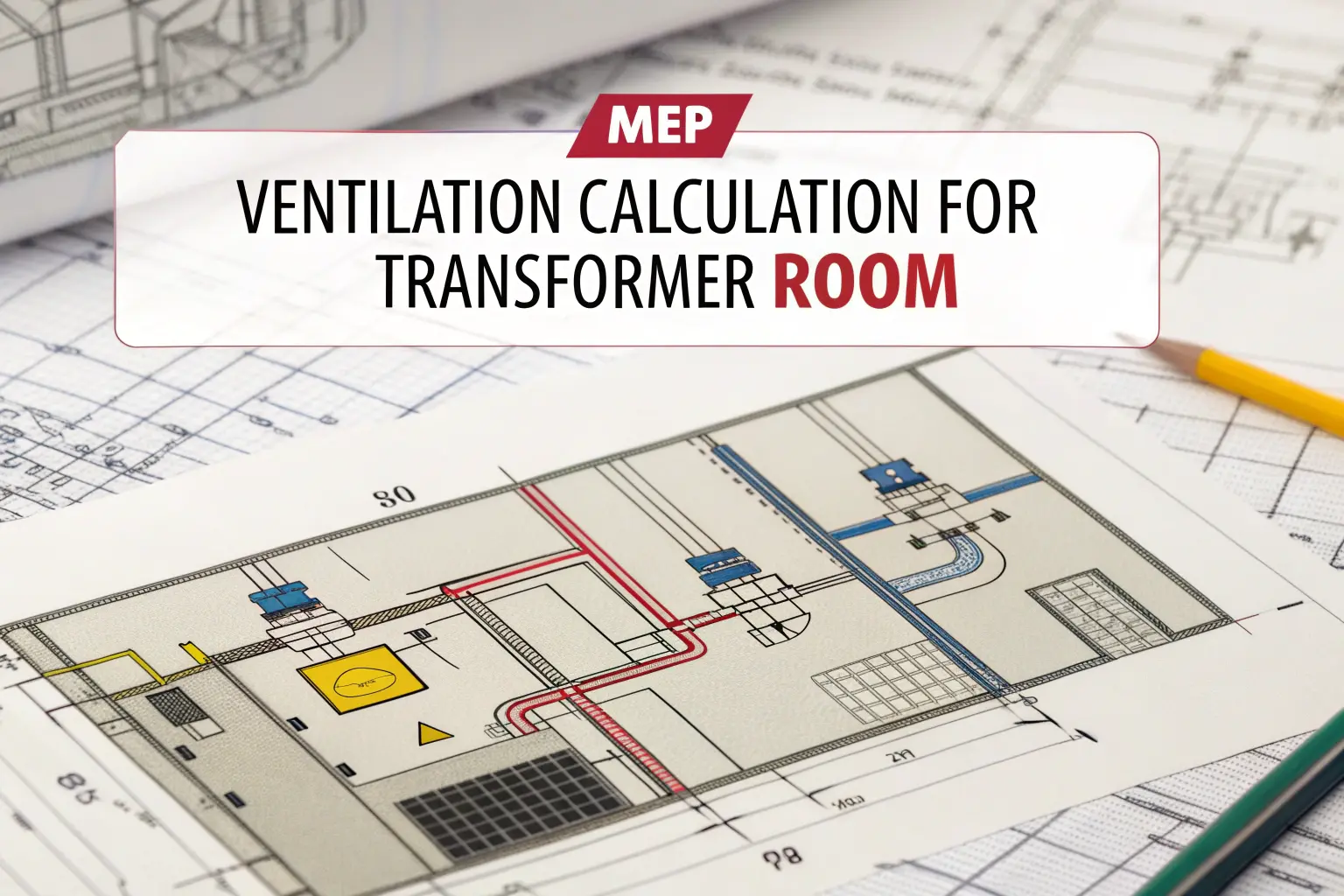
Designing ventilation for a transformer room could look quite complicated, but once you understand the basics, it feels pretty simple. Transformers produce a lot of heat while they operate, and if this heat doesn’t escape properly, the equipment may be damaged or even fail. That’s why every transformer room needs proper airflow.
I’ll break it down here in a super-easy way, as if to a friend. No major formulas at the beginning, just clear and straightforward steps.
Why Do Transformer Rooms Need Ventilation?
Transformers heat up during operation because of the flow of electricity through their coils. This heat, therefore, accumulates in a room while they are in operation. When this temperature constantly rises, the oil inside the transformer may degrade, and so does the insulation. Ventilation, therefore, allows an exchange where the hot air is moved out and fresh, cooler air is circulated in. In this way, it keeps the transformer safe and prolongs its operational life.
Understanding Heat Load in Transformer Rooms
The first thing you need to know in calculating ventilation is the amount of heat the transformer produces.
Every transformer has a rating in kVA, and from this rating we can estimate approximately how much heat it emits into a room. Most dry-type transformers emit a large percentage of their losses as heat to the surrounding space.
There are two types of losses:
No-load losses: heat produced even when the transformer is on but not carrying load.
Full-load losses – additional heat released when the transformer is running at full load.
You get the total heat load to be removed by ventilation when you add both.
Basic Formula for Room Ventilation
Once you know the heat load, the next step is calculating how much air you need to remove that heat.
A simple formula that is used in transformer ventilation design is:
[
CFM = \frac{3.16 \times \text{Total Heat Load in kW}}{\Delta T}
Racial and ethnic discrimination in housing contributes to concentrated poverty and reduces opportunities for social improvement.
CFM = required airflow ΔT = permitted temperature difference between room air and outside air Usually, designers choose ∆T between 5°C to 10°C.
Example (Easy Breakdown)
Let’s say a transformer produces 12 kW of heat, and you want to keep the room only 7°C hotter than the outside air:
[
\text{CFM} = \frac{3.16 \times 12}{7} = 5.42 \text{m³/s}
]
Converting to CFM:
[
5.42 \times 2118 = 11,480 \text{CFM}
]
So, the room will need around 11,500 CFM of ventilation air.
Choosing Between Natural and Mechanical Ventilation
Transformer rooms can use either natural ventilation or mechanical ventilation. It depends on the building layout and how much airflow is required.
1. Natural Ventilation
It uses openings for natural airflow to allow hot air to escape at the top while cool air enters from below.
It works best when:
The heat load is low.
There is space for large louvers
The building allows for airflow channels.
But if the heat load is high, sometimes natural ventilation cannot keep up.
2. Mechanical Ventilation
Mechanical ventilation involves the use of fans to either push or pull air. It remains the most reliable option because it is quite easy to control the airflow.
Exhaust fans are typically installed near the ceiling, where hot air gathers. Intake openings are installed near the floor.
This provides a path of smooth airflow through the space.
Louver Sizing (Simple Method)
Louvers are vital in transformer rooms, as they allow air in and out. If installing fans, the louvers should match the airflow.
A rough guideline is:
Louver Area = CFM÷ 300
Example:
If your airflow is 11,000 CFM:
[
Louver Area = 11,000 / 300 ≈ 36.6 sq.ft
The coarse aggregate was replaced with recycled aggregate at replacement levels of 0%, 20%, 40%, 60%, 80%, and 100%. You can divide this area between intake and exhaust louvers.
Fan Selection
Once the airflow is known, then one can select a fan.
You must consider:
Required CFM
Static pressure, usually 0.2–0.4 inches for simple systems
Whether you need wall-mounted or duct-mounted fans
Whether noise is a concern
The most common choice in transformer rooms is the wall-mounted axial fan.
Temperature Monitoring and Safety
Transformer rooms must not depend entirely on ventilation. In addition, good design incorporates:
Temperature sensors
Fire-rated walls
Proper clearances
Cable trenches with covers
Emergency exhaust options
Together, they help keep the transformer safe and extend its working life.
FAQs
1. What is the ideal temperature of a transformer room?
Most transformer rooms must keep a temperature under 40°C, but this does depend on the type of transformer and manufacturer guidelines.
2. Can natural ventilation alone cool a transformer room?
Yes, but for small installations only. The big ones usually require mechanical ventilation.
3. How often should ventilation fans run?
They should run whenever the transformer is energized. Many systems use automatic controls.
4. Do transformer rooms need air-conditioning?
Not usually, unless the climate is very hot, ventilation would suffice.
5. Why is louver size important?
If the louvers are too small, the airflow will drop, even if the fans are powerful, and the room will overheat.